


Preface
While most of the world talks about how "AI coding," "Vibe Coding," "Cursor," and "Claude Code" will replace human engineers, I believe there is another possibility. It will go far beyond replacing "coding" itself — namely:
A change in "interaction"
When interaction changes, we will no longer need "traditional web interfaces" — login pages, sign-up flows, shopping carts. In other words, we will no longer need "clicking, swiping, and navigating." What does that mean?
LLMs will become the next generation of interaction — and the GUI will disappear entirely
In other words, without the traditional GUI, all we need is a single: "dialog box"
An AGI-powered dialog box will replace the interface-driven interaction model of the Web 2.0 and Web 3.0 eras
Remarkable, isn't it? It means today's "coding agents" are not the ultimate reason human engineers will be replaced. Of course, "coding" is only a small part of the development lifecycle — computer science (CS) is not just about programming. But regardless:
What truly replaces human engineers is a change in interaction — and only a fundamental shift in how we interact can change the world
This is not nonsense or fear-mongering. It is happening at the world's most cutting-edge AI companies right now. You may work in the industry, or you may not — but either way:
We are living through a transformation on par with the Industrial Revolution — one of the greatest shifts in human history: the AI revolution, and it is faster and more comprehensive than anything before.
Historical Overview
Looking across history, we reach a striking conclusion: every revolution in interaction has given rise to a new hegemon.
According to companiesmarketcap.com data as of July 22, 2025:
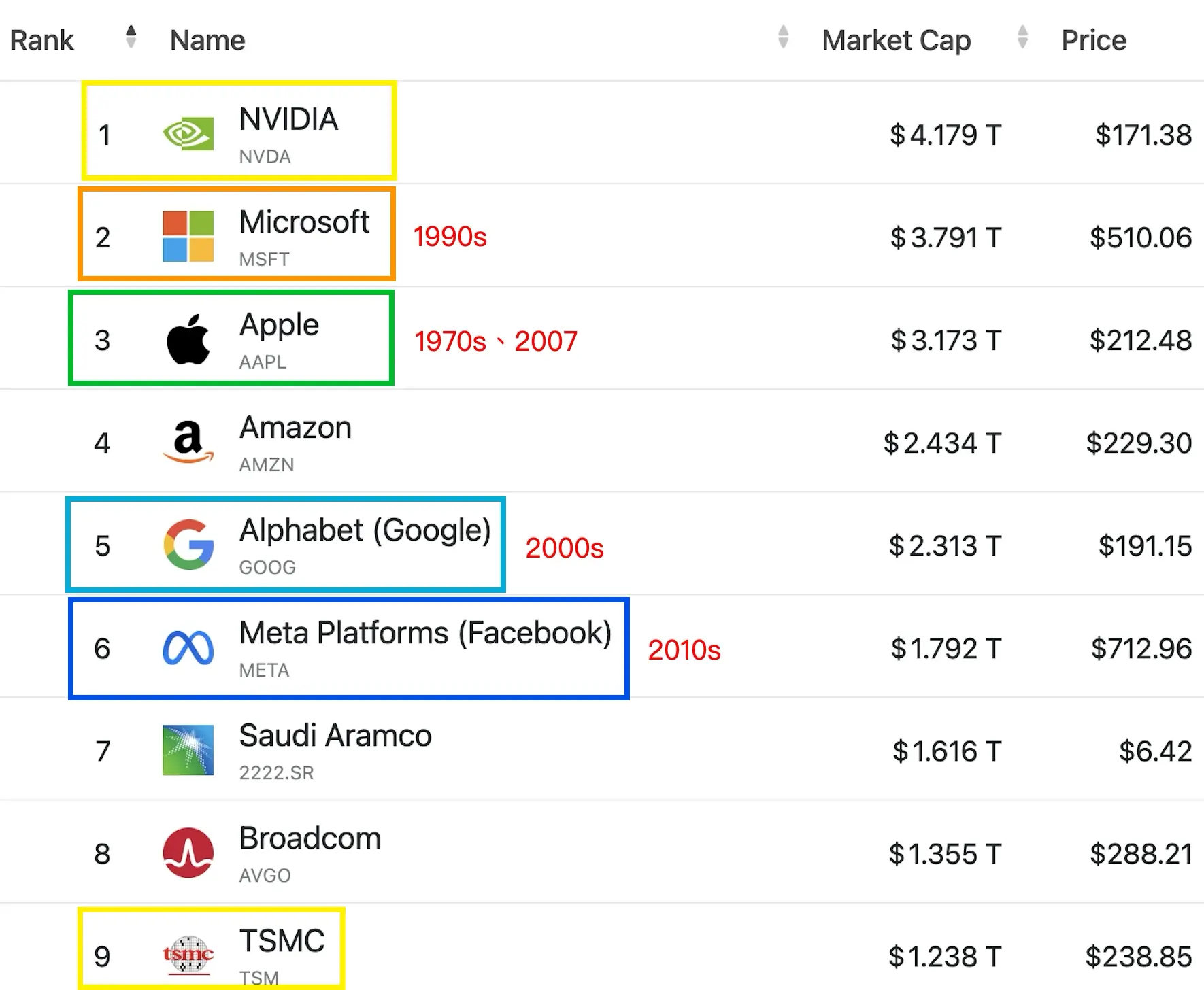
(As a side note, while proofreading, Google's market cap had already surpassed Amazon to become the world's 4th-largest company. Nano-Banana and Veo3 from earlier were truly impressive — looking forward to Gemini 3.0 in a few weeks, 2025/09/29)
You can see that most of today's top 10 companies by market cap are leaders of their era's "interaction revolution."
| Era | Interaction Shift | Revolutionary Product | Rising Company | Later Position |
|---|---|---|---|---|
| 1970s | Command Line (CLI) | UNIX | AT&T / IBM / DEC | Laid the foundation for mainframe and engineering culture |
| 1980s | Graphical Interface (GUI) | Macintosh | Apple | Ignited the personal computer era; became a symbol of design and innovation |
| 1995s | Browser × Hyperlinks | Netscape / IE | Microsoft | Windows + IE dominated the global OS and browser markets |
| 2000s | Search + Web 2.0 | Google Search | Google | Built an information index and ad empire; became the gateway to the web |
| 2007 | Touch + App | iPhone | Apple (Resurgence) | Rewrote mobile, ecosystems, and hardware supply chains; App Store became a gold mine |
| 2010s | Social Interaction + Mobile Content | Facebook / Instagram | Meta (formerly Facebook) | Captured human attention and social scenes; built an ad empire |
| 2022 | Conversational AI (LLM) | ChatGPT | OpenAI | Ignited the AI interaction wave; from tool to AI revolution |
| 2025+ | Agents (AGI) | ? | ? (hopefully Txaion is here) | Control semantics + task entry = own the next-generation Web |
The essential reason is that "interaction" = the bridge between humans and information. Whoever controls that bridge controls the entry point, attention, time spent, and data flow — and thus naturally monopolizes market position.
From the table above, humanity has seen many interaction revolutions, but my favorite example is Google — the symbol of the millennium's interaction revolution, which changed how people interact with information. Before Google, early portals like Yahoo! relied on human editors to organize websites into layered tree categories (e.g., News → International News → Asia → Taiwan). This was somewhat like a library catalog — categorized, but slow and limited in coverage, requiring constant manual updates. To be precise, before Google there were also search engines like AltaVista, Lycos, and Ask Jeeves — but Google truly changed how people interact with information, becoming the gateway to the web.
How exactly did all of this happen? Will LLMs rewrite the world order in the next 5–10 years?
This article will explore these cutting-edge views — and why now, why the AI revolution is happening right now.
From CLI to Google Search, to the iPhone touch revolution, and now ChatGPT's conversational interface — these revolutions are not just technical shifts, but:
1. A restructuring of human-computer relationships
2. A reshuffling of usage habits
3. A transfer of dominant power
In summary, whoever masters the "new interaction" first will define the ecosystem and platform rules for the next decade — it will be a platform-level entry point.
Why Revolution, Golden Elements
Let's rewind the timeline to the era we are living through. Start with a simple question:
Why have apps and websites grown at such an unprecedented, explosive pace?
I believe there are essentially two "golden elements":
1. Low cost
2. Ease of use
The First Website
In August 1991, Tim Berners-Lee launched the first site at CERN (CERN web history), marking the beginning of the Web 1.0 era and pushing the entire information age onto the network.
Explosive Growth
According to Niccolo Conte, Visualized: The Growth of Global Internet Users (1990–2025):
| Year | Internet Users | % of Global Population |
|---|---|---|
| 1990 | 2.6M | 0.05% |
| 1995 | 39.2M | 0.7% |
| 2000 | 361M | 6% |
| 2005 | 1.0B | 15% |
| 2010 | 1.9B | 27% |
| 2015 | 3.0B | 40% |
| 2020 | 4.5B | 57% |
| 2025 | 5.6B | 68% |
Over 35 years, the global online population surged 2,154×. Modern society has nearly all human activity built on this foundation.
Revolution is a historical inevitability
Today, global internet users have reached 5.6 billion. The next wave of growth will not come from "headcount". That is why the Web has entered saturation — yet the world never stops advancing. History repeats in striking ways:
When growth hits a ceiling, transformation follows — and that transformation is a "change in interaction," where "semantic interaction becomes the next explosion point."
There is nothing permanent except change.
This is a profound quote. I believe whoever can see what will change in the future will control the future. From this we derive:
Revolutions share a common pattern: golden elements
1. Low cost
2. Ease of use
1. Low Cost
Compared to before the millennium (2000), falling development costs enabled a wave of software companies — Silicon Valley and software industries worldwide over the past decades are the best proof.
2. Ease of Use
Modern devices are simple and convenient, bringing in massive user bases. With just clicks and swipes, people can accomplish things that were unimaginable in the past.
In this cycle, a powerful flywheel effect forms — and explosive growth begins.
And now, "LLM" possesses these golden elements
Revolution Begins — Moore's Law, Huang's Law?
LLM Cost Decline
First, we know that every generation of an "LLM" is essentially performing many "matrix operations", which requires massive "compute power", leading to "high costs." However, this situation is being "resolved."
GPT-4 Cost Down 83%
According to OpenAI GPT-4 API Pricing on www.nebuly.com: "In just 16 months, we saw OpenAI's GPT-4 token prices drop 83% — output tokens fell from $60 per 1M tokens to $10 per 1M tokens, and input tokens from $30 per 1M tokens to $3 per 1M tokens."
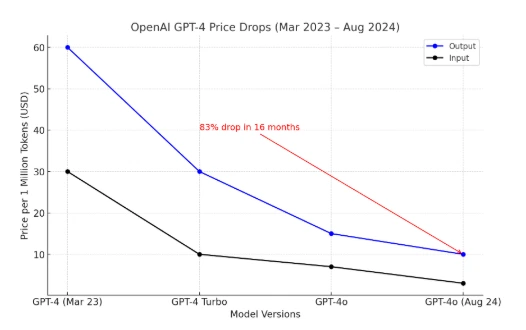
This is just for the GPT-4 model alone — other LLMs follow the same trend, and I believe this is only the beginning.
Moore's Law
Moore's Law is a 1965 technology prediction by Intel co-founder Gordon Moore. Its core content:
"When cost is held constant, the number of transistors on an integrated circuit roughly doubles every two years. (Meaning computing power doubles while price, power consumption, or area remain stable.)
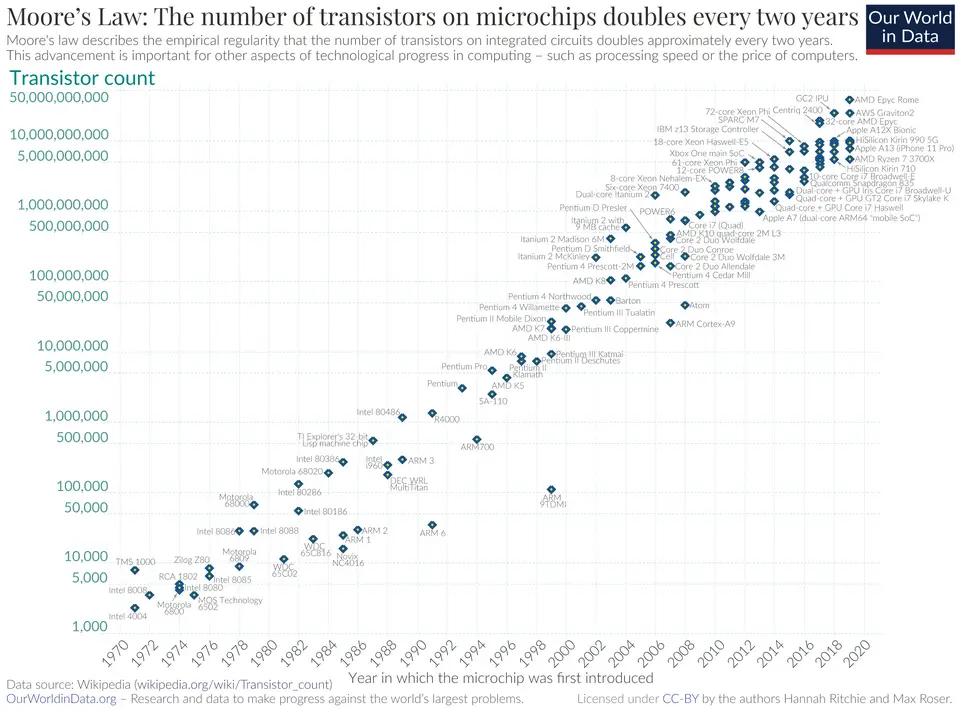
Image source: Moore's Law — Wikipedia
Moore observed that as process technology advanced (e.g., 90nm → 45nm → 7nm), more transistors could fit on the same wafer area, leading to:
Higher compute performance
Better performance per watt (performance / power)
Lower cost (more performance per chip)
Performance, performance, performance — broadly speaking, it means:
Every 18–24 months, computer performance doubles while price stays relatively flat.
Moore's Law is not a law of physics, but a "self-fulfilling prophecy" of industry rhythm and innovation pressure. The entire semiconductor industry (Intel, TSMC, NVIDIA, Apple, Samsung, etc.) marches to this rhythm.
Post-Moore Era
In recent years, Moore's Law has gradually slowed, and some scholars argue:
Process advancement costs are exploding (e.g., 2nm R&D exceeds $10 billion)
Heat dissipation and current leakage are becoming bottlenecks
Design complexity is soaring — EDA tools and talent costs are rising
Thus, Moore's Law has entered the "physical limit", and can no longer double every two years.
To sustain performance growth, the industry is taking multiple paths:
Chiplet architecture: AMD Ryzen, Apple M series — combining multiple small chips into one large chip
3D packaging: TSMC SoIC, Intel Foveros — increasing vertical stacking density
AI-specific chips: NVIDIA H100, Google TPU — dedicated AI acceleration, not CPU scaling
Hardware-software co-optimization: Apple integrating CPU + GPU + RAM + SSD + iOS for unified efficiency
Moore's Law was once the benchmark of tech progress, but we are entering the "post-Moore's Law era". The focus is no longer just stacking transistors, but: architectural innovation + system integration + algorithm breakthroughs.
GPU and Moore's Law
The relationship between GPU and Moore's Law follows "beneficiary" → "driver" → "breakthrough maker", but ultimately still hits Moore's Law physical limits. Here we break it into 3 phases:
Phase 1: GPU as Moore's Law Beneficiary
During Moore's Law's golden era of 1995–2010, GPU performance grew leaps and bounds every year — doubling every two years while costs fell. A classic case of "Moore's Law".
Performance:
Performance doubled every 1.5 years (matching Moore's Law expectations)
Representative products: NVIDIA GeForce series from MX400 → 8800GTX → GTX980
Game graphics, image processing, and GPU applications broke through year after year
Reasons:
Process advancement (90nm → 65nm → 45nm)
Higher transistor density → more cores → stronger parallel processing
Phase 2: GPU as Moore's Law Driver
After 2012, AI took off and GPUs began driving compute development:
NVIDIA Kepler (2012) popularized GPGPU
Volta (2017) introduced Tensor Core for deep learning acceleration
A100 / H100 / B200 / Blackwell (2020–2025) designed entirely for AI
At this point, GPUs were no longer just "riding Moore's Law" — they were:
Packing more transistors onto larger die areas
Integrating HBM high-bandwidth memory and high-speed interconnect (NVLink)
Developing more complex units (SM, Tensor Core, Ray Tracing Unit)
Example: NVIDIA Hopper (H100) with 80 billion transistors, TSMC 4N process, over 800W TDP (cooling becomes a major challenge)
Phase 3: GPU Hits "Moore's Law Slowdown"
GPU bottlenecks are now clear:
Process advancement slowing: beyond TSMC 3nm, 2nm and 1.4nm development difficulty is exploding
Power surge: H100 single-card TDP reaches 700W — data center power limits
Design complexity soaring: each generation requires billions in R&D and validation
Memory constraints: HBM capacity and bandwidth become bottlenecks, underutilizing compute
Phase 4: Post-Moore's Law, Huang's Law
NVIDIA and TSMC — the forces behind the scenes
Let's return to the beginning — remember the top 10 companies by market cap we mentioned? Of course there are many other excellent semiconductor companies in the world — Amazon's "Bedrock," Broadcom's "Tomahawk Ultra," and others are all remarkable products.
According to companiesmarketcap.com data as of July 22, 2025:
Back to the point — you can see we've highlighted NVIDIA and TSMC. Why is that?
Huang's Law — LLM Training Almost Entirely Depends on NVIDIA GPUs
Today's cutting-edge models — GPT, Claude, Gemini, Mistral, LLaMA, and others — predominantly use NVIDIA H100 / A100 / V100 chips during training. Of course, Google's TPU (Tensor Processing Unit) also provides stable, low-power, low-cost inference on Google Cloud — but training large models (over 100 billion parameters) still relies on NVIDIA.
Faizan Farooque, Nvidia Secures 92% GPU Market Share in Q1 2025 notes: "According to Jon Peddie Research, Nvidia (NVDA) captured 92% of the add-in board GPU market in Q1 2025."
~90% market share — astonishing data. But why do these customers trust NVIDIA?
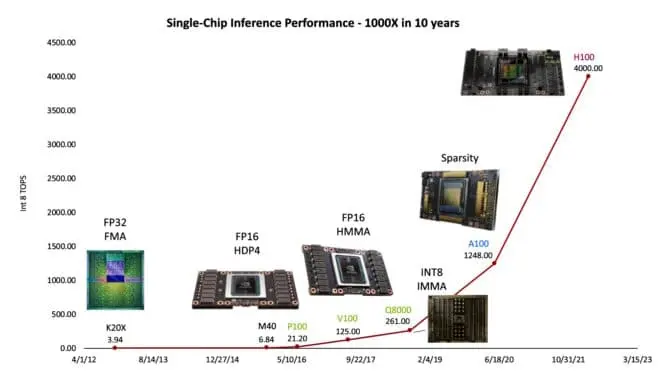
Image source: Following Huang's Law: Video Shows How Engineers Keep Accelerating — Rick Merritt — NVIDIA Official Blog
NVIDIA Chief Scientist Bill Dally describes in the article above the massive shift in how post-Moore's Law computer performance is achieved. First, in the chart we can see single-chip inference performance improved "1,000×" over ten years — equivalent to doubling every 1.08 years, and this trend is still ongoing. How was all of this achieved?
GPU Didn't Break Moore's Law — It Escaped Its Cage
GPU didn't break Moore's Law — it used "system stacking" to push Moore's Law's endpoint back by 10 years. Through architectural innovation + packaging integration + power sacrifice + software stack:
Chiplet architecture: NVIDIA Blackwell uses 2 cores for B200 — if one chip can't fit, split into two
High-bandwidth memory integration: HBM3E stacked directly on core for faster data flow
CoWoS / 3DFabric: TSMC advanced packaging — stacking chips like LEGO
Dedicated acceleration units: Tensor Core for matrix ops; future LLM-Core may run large language models natively
We have long surpassed the "process iteration" era — entering a new age of "structural liberation, packaging revolution, and hardware-software synergy."
Of course, none of this comes without cost. NVIDIA Chief Scientist Bill Dally also notes in the article:
Cost surge: an H100 card costs over $30K USD; industrial B200 systems cost tens of millions
Power explosion: single-card TDP up to 1000W — data centers built like power plants
Cooling limits: massive server deployments require liquid cooling — air cooling can't keep up
Engineering complexity: design must integrate packaging, HBM, interconnect, Tensor optimization, software stack
But none of this changes one fact: single-chip inference performance improved "1,000×" over ten years — costs still fell compared to the past. Rather than a continuation of Moore's Law, this is Moore's Law "going off the rails" — unit compute cost plummeting. That is the root of the revolution:
In the past, a server delivered 1–5 TFLOPS for tens of thousands of dollars
Now a single H100 delivers hundreds of TFLOPS — high unit price (over $30K USD), but cost per TFLOP is extremely low
Even according to internal OpenAI/Anthropic data:
GPT-3 inference cost per training run ≈ a few dollars → GPT-4 + H100 each run < $0.10 USD
This is a violent cost collapse — not a gradual decline. And so:
Golden Elements Achieved
1. Low Cost
"AI will become like utilities — nearly free infrastructure."
2. Ease of Use
Explaining ease of use is simpler than low cost, because:
LLM is ease of use itself
In other words: LLM is the most user-friendly product in history.