


Cloud High Availability is a Consensus Illusion
While writing the Txaion Tech Stack article (2025/11/18), when discussing the Edge & Network section, I coincidentally encountered the Cloudflare Global Large-Scale Outage. It was quite a coincidence. Interested readers can refer to the incident report published by Cloudflare CEO Matthew Prince in the link above. Additionally, I would like to write an article about the history of CDN and Edge Network development, introducing how Cloudflare became a global top-tier CDN provider through innovative CDN technology and business strategies. If I do write it, it might appear here.
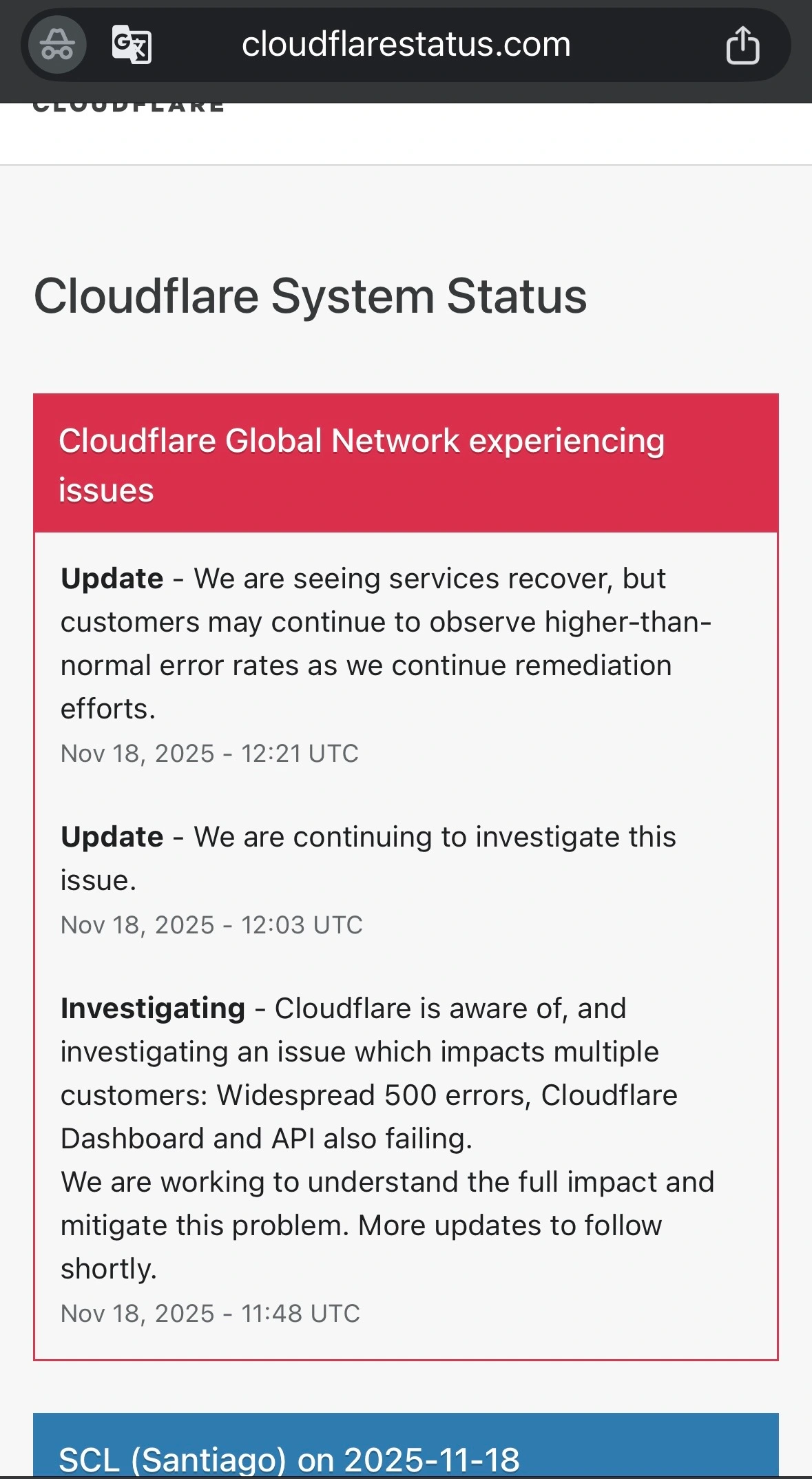
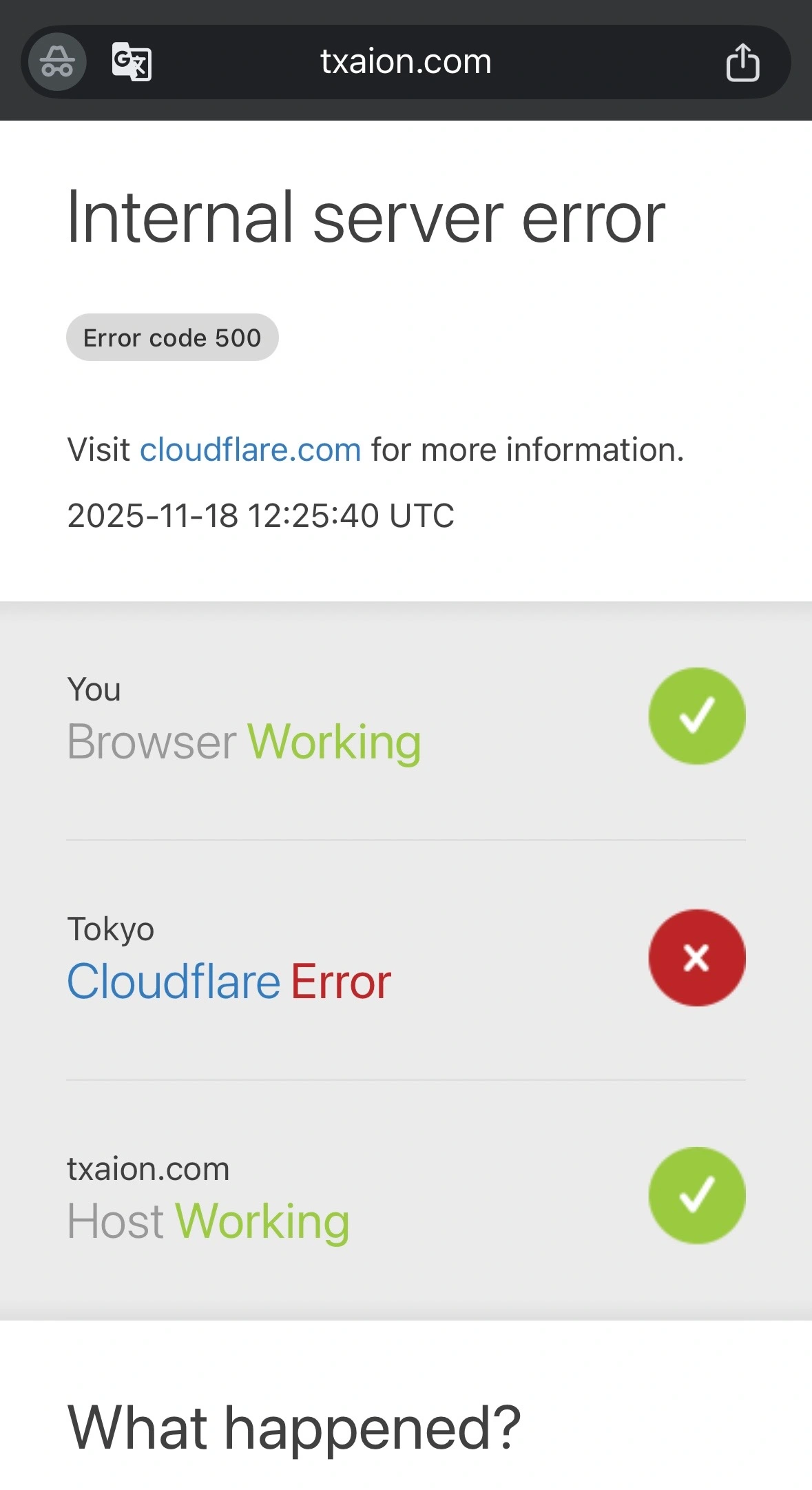
Attached are screenshots I took on my phone at the time (2025/11/18), showing the Cloudflare global large-scale outage event.
From the AWS Outage global large-scale outage event in October 2025, to the Cloudflare Outage global large-scale outage event in November 2025, within just one month, two major global network-level infrastructure providers collapsed. This is not a coincidence. It's a mirror of the entire Web2.0 architecture:
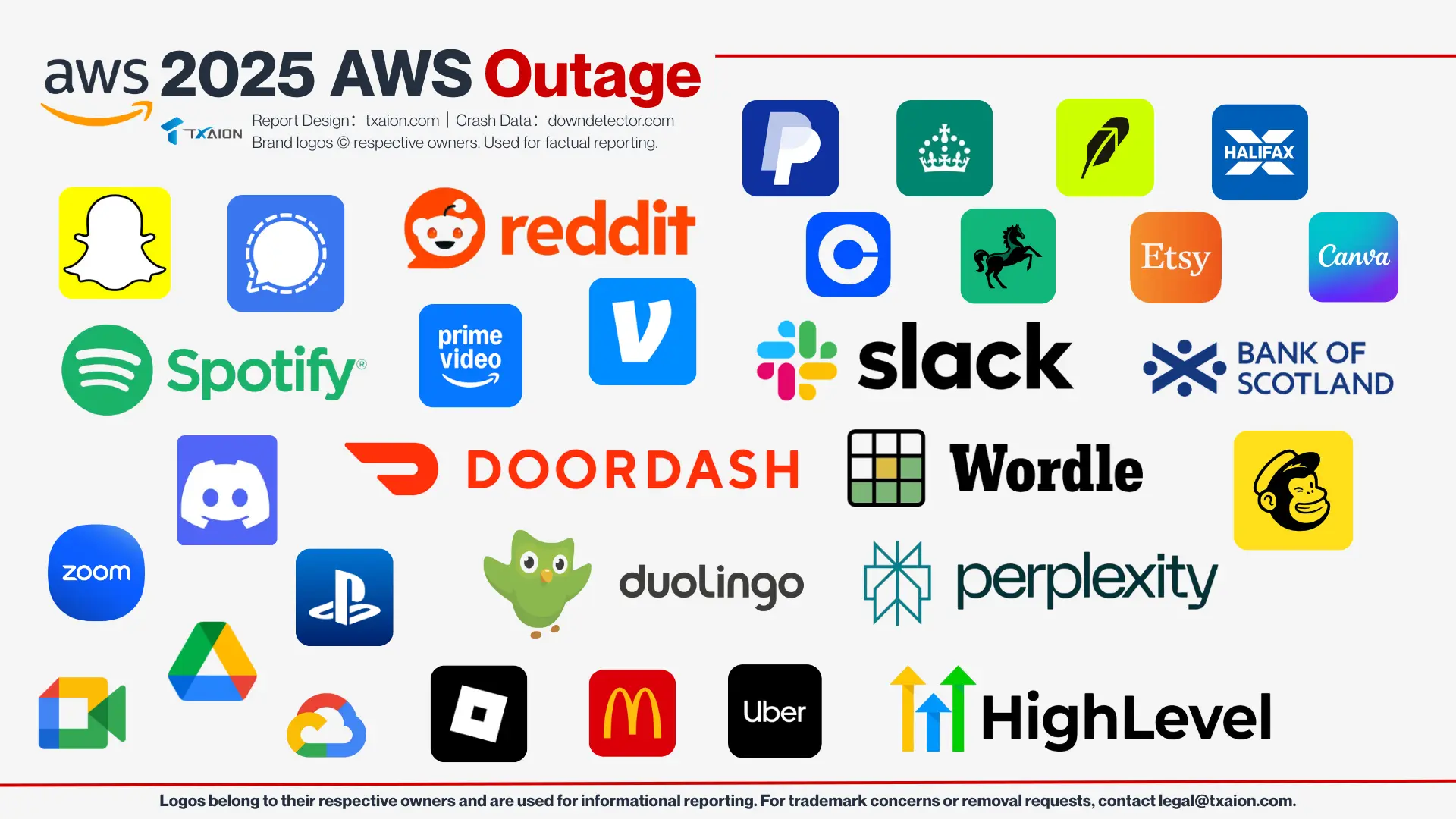
Image source: Txaion (self-created)
Whether it's AWS, which holds approximately 30% of the cloud computing market share, or Cloudflare, which holds approximately 25% of the CDN market share, they cannot stand firm in the face of global incidents.
We have handed over the survival rights of the global network to a very few centralized nodes.
But reality is harsh. The so-called:
- 99.99% High Availability (HA)
- Distributed Architecture
- Multi-region Failover
- 100% SLA Guarantee
When core architecture issues occur, these become meaningless.
AWS claimed cross-AZ high availability, yet services like DynamoDB, EC2, NLB, Lambda, ECS, EKS, and IAM (directly or indirectly affected by DynamoDB) crashed simultaneously.
Cloudflare's case was even more absurd—a configuration error caused by "a single line of Rust code (unwrap())" led to Cloudflare's years of touted "Zero Trust + Global Anycast + 100% SLA" ending in a global large-scale outage.
Distributed? Wrong, it's centralized sharding.
High Availability? Wrong, it's an illusion of single-point dependency.
Cloudflare's major outage is no longer a question of "if it will happen," but "when it will happen again."
We've Turned Cloudflare into the 'Abstraction Layer of the Entire Internet'
Cloudflare's positioning is no longer just a simple CDN, but a multi-layered network service:
- DNS Authority
- Global Anycast Edge
- DDOS Shield
- Workers = Compute Edge
- WAF = Zero Trust
- R2 = Edge Storage
- Argo / Magic WAN = Routing Layer
It's actually a "decentralized abstraction layer" before Web3, just centrally hosted on Cloudflare. When a single company takes on too many network functions, it becomes the single point of failure for the internet.
This incident proves:
The entire internet is becoming centralized again, not decentralized.
This contradicts the original intention of transitioning from Web2 to Web3, which will be explained in detail below.
We Pretend Anycast = Won't Go Down
Global Anycast appears to provide "cross-point fault tolerance," but:
Anycast is multiple entry points, not multiple providers.
Once the source routing strategy fails -> global simultaneous outage.
The essence of this Cloudflare incident was not hardware failure, but:
- routing path decision errors
- edge node propagation errors
- global policy simultaneous deployment
In other words, architectural-level logic errors -> will cause global simultaneous failures. This wasn't a network failure, hacker attack, or hardware explosion, but Cloudflare's "automated global consistency architecture" being triggered by a single erroneous config, causing all Edge nodes worldwide to fail simultaneously. Cloudflare's automated update mechanism is so powerful that it can automatically synchronize errors to all global nodes.
This is Not an Isolated Incident, It's a Web2.0 Structural Problem
We have reached a contradiction:
| What Cloud Gives Us | But The Cost Is |
|---|---|
| Faster Time to Market | Less Architectural Control |
| Global Deployment | Single Vendor Centralization |
| Serverless Abstraction | Black Box Dependency Chain |
| Automation | One Error Synchronizes Globally |
What Cloud Gives Us
Faster Time to Market
But The Cost Is
Less Architectural Control
What Cloud Gives Us
Global Deployment
But The Cost Is
Single Vendor Centralization
What Cloud Gives Us
Serverless Abstraction
But The Cost Is
Black Box Dependency Chain
What Cloud Gives Us
Automation
But The Cost Is
One Error Synchronizes Globally
The higher the service abstraction layer, the higher the risk concentration.
Cloud computing, due to abstraction, hosting, and integration, has made the entire network infrastructure layer operate more like a single company than ever before.
AWS goes down -> global enterprises collapse
Cloudflare goes down -> the entire Web returns 404
Google goes down -> both Web3 and Web2 stop working
Is that still truly a "distributed architecture"? Multiple nodes but operated by a single vendor—it's more appropriate to call it a distributed overlay network operated by a centralized vendor. This essentially addresses issues like risk concentration in monolithic services, high concurrency performance, and stability, but the "single point of failure" risk still exists. Perhaps distributed architecture shouldn't be limited to just this.
As a side note, it's interesting that many Web3 projects today are also moving toward this centralized-operated distributed overlay network direction, completely contradicting the original intention of Web3 and blockchain. They have distributed nodes, but centralized management institutions.
In the Web3 world, there is a group wearing the cloak of Web3 but actually operating as centralized Web2 entities that are destroying the original intention of Web3. While it's true that Web3 may have needed centralized operation in its early stages, or perhaps due to regulatory requirements, maybe it's time to reconsider now.
SLA is a Legal Document, Not a Guarantee
The cloud industry treats SLA as marketing terminology, but:
- SLA is not a "guarantee that it won't go down"
- SLA is "if it goes down, we'll compensate you"
- And compensation is often far less than the loss
What you get is not an SLA, but a "discount code after an incident occurs." 100% SLA (as Cloudflare mentioned) is just: if it goes down -> refund, not a zero downtime guarantee (Zero Downtime Guarantee).
SLA is a shield that protects cloud providers, not a weapon that protects services.
The Real Problem: We Take PaaS for Granted
Modern development has long been accustomed to:
- CDN handles edge cache for you
- DNS handles routing for you
- WAF blocks attacks for you
- Workers handle compute for you
- S3/R2 handles storage for you
- IAM handles authentication for you
Then one day, you discover that this entire chain is actually: a single abstraction layer provided by one company. When this layer goes down, it's not just "the website is down," but:
- User authentication fails
- All access tokens fail
- WebSockets are blocked by Proxy
- CDN cache miss -> Origin overload
- Logging/Metrics all disconnected
- Certificates/Zero Trust all offline
I know that modern development with these Serverless, Tooling, and PaaS services is great, and I use them too. In most scenarios, whether it's cost, stability, or performance, I fully agree with such a Tech Stack, but perhaps we have better solutions.
The Next Step is Not 'Switching Providers', But 'Architectural Decentralization'
If this incident is to teach us a lesson, it shouldn't be:
- Don't use AWS
- Don't use Cloudflare
- Don't use cloud computing
- Don't use other CDNs
- Don't rely on any centralized nodes
But rather:
Don't let any single company become the lifeline of the entire infrastructure
The direction of next-generation architecture will be:
- Decentralized Architecture
- Decentralized Computing
- Decentralized Storage
- Decentralized Network
- Multi-CDN / Multi-Entry Architecture
- Server-Independent Edge Inference
- Client Fallback Mode (Offline Capable)
In other words:
Not moving to the cloud, but moving across clouds.
Not relying on the network, but being able to operate normally when the network fails.
Web2's centralized cloud architecture has reached its limit.
We need to design a world where systems can still function even when the cloud is disconnected.
From another perspective, this is an incident caused by architectural limits, perhaps marking the turning point from Web2 -> Web3.
In the next 5 years, edge networks and Tech Stacks worldwide will become more complex. I also understand that true decentralization still has a long way to go, which is why, before that, I want to provide you with a real solution, rather than the still-distant "true decentralization":
Starting from the bottom layer, abstracting any architectural level into "switchable" solutions, and depending on multiple centralized nodes and multiple vendors, is another form of "decentralization" solution.
Finally, I need to prepare for my special talent admission interview at National Taiwan University. After I get admitted to university, we can discuss other interesting topics. I've also recently looked at the Palantir - Meritocracy Fellowship recruitment program, which aims to recruit a group of excellent, promising high school graduates, skipping university and directly entering the company, challenging the traditional higher education system.
I'm quite supportive of this. In the future, when Txaion reaches the seed round and starts hiring, I also want to hire based on ability rather than education, recruiting a group of people the world considers "weirdos" to disrupt the entire industry together. Interestingly, many students accepted into this program are also admitted to prestigious universities, which seems somewhat ironic, but from another perspective, it also proves that prestigious universities do have the ability to identify "excellence," or perhaps it's because they were admitted to prestigious universities that they were accepted into the program? I haven't delved deeper into this part. I hope readers who understand this program can help me add more accurate information. Thank you, and may everything be well. I'm off to my interview—wish us luck!
Sources
- Cloudflare Outage Global Large-Scale Outage Event - Official announcement by Cloudflare CEO Matthew Prince
- Summary of the Amazon DynamoDB Service Disruption in the Northern Virginia (US-EAST-1) Region - AWS global large-scale outage event
- AWS Outage - impacted company list - List of companies affected by AWS global large-scale outage event
- The Latest Cloud Computing Statistics - Introduces the latest cloud computing statistics, mentioning that AWS is the largest cloud provider with approximately 30% market share.
- CDN Providers Market Report - Introduces the current state of the CDN market, mentioning that Akamai is the largest CDN provider with 30% market share, and Cloudflare is the second largest with 25% market share.
- Cloudflare Enterprise Support SLA - Cloudflare 100% SLA guarantee
- Akamai Company History - The earliest CDN company
- The History of Content Delivery Networks (CDN) - Introduces the history of CDN
- Beyond Cloud Computing, There's Fog Computing!? An Introduction to Fog Computing and Use Cases - Introduces fog computing basics and use cases
- [Industry Perspective] The Rise of Edge Computing, Giving Birth to a Three-Tier Cloud Architecture - Introduces the rise of edge computing
- What is Anycast? - Introduces the definition of Anycast
- AWS Outage 2019 Route 53 - AWS 2019 Route 53 large-scale outage event